

An underwater metal detector can help locate a lost ring, coin or metal object in places where recovery is permitted. Buying one for scuba diving, however, is different from picking a beach detector. A waterproof search coil is not enough: the entire assembled unit needs a submersion rating appropriate to the dive. The way it responds to saltwater, the signals you receive underwater and the amount of ground you can cover matter as much as the headline specifications.
We compare five underwater metal detectors for different jobs, from recovering a lost ring in a small area to regularly searching larger stretches of seabed.
Affiliate disclosure: Some Amazon links on this page may earn ScubaProMax a commission if you make a purchase, at no extra cost to you. Verify the model and kit contents before ordering.
Quick verdict: Choose the Minelab Excalibur II for dedicated, full-size scuba detecting in saltwater; the Nokta PulseDive Scuba Detector for compact recovery work; or the Quest Scuba Tector Pro when a folding coil and packable design appeal. The Fisher CZ-21 is a specialist alternative with a 76 m published rating and tonal target discrimination. The XP DEUS II is best considered by someone who also detects on dry land and can follow its additional underwater setup requirements.
Underwater metal detectors compared
| Detector | Best for | Waterproof depth | Technology | View product |
|---|---|---|---|---|
| Minelab Excalibur II | Full-size scuba searching | 60 m / 200 ft | BBS multi-frequency | View on Amazon |
| Nokta PulseDive Scuba Detector | Compact recovery | 60 m / 200 ft | Pulse induction | View on Amazon |
| Quest Scuba Tector Pro | Folding handheld design | 60 m / 200 ft | Pulse induction | View on Amazon |
| Fisher CZ-21 | Deep-rated, audio target ID | 76 m / 250 ft | Dual frequency | View on Amazon |
| XP DEUS II | Land and moderate-depth dives | 20 m / 66 ft* | FMF multi-frequency | View on Amazon |
*The XP DEUS II requires the manufacturer’s specified underwater configuration, including the correct cap and underwater antenna. These are equipment depth limits, not recommendations for how deep anyone should scuba dive.
Weight, batteries and underwater signals
| Detector | Weight | Battery and runtime | Underwater alerts | Target discrimination |
|---|---|---|---|---|
| Minelab Excalibur II | 2.3 kg / 5.1 lb (10-inch configuration) | Rechargeable 12 V NiMH pack | Hardwired waterproof headphones | Variable discrimination; tonal response |
| Nokta PulseDive Scuba | 550 g / 19.4 oz including coil cover | Rechargeable 1650 mAh lithium-polymer; about 2 hours to charge | Audio, vibration and LED; vibration/LED recommended in dive mode | Basic detection alerts; no target-ID screen |
| Quest Scuba Tector Pro | Weight not stated on current manufacturer page | USB-C rechargeable; runtime not stated on current manufacturer page | Selectable alarm modes; check the supplied manual for underwater settings | Compact PI detector; no full-size target-ID system |
| Fisher CZ-21 | 5 lb 11 oz (8-inch coil, with headset) | Four 9 V batteries; published alkaline life 35–55 hours | Waterproof headset; three-tone target ID | Seven preset discrimination settings |
| XP DEUS II | From 750 g; varies by coil, controller and accessories | Rechargeable lithium batteries; RC up to 25 hours, coil up to 20 hours, depending on settings | Compatible waterproof wired audio required for diving | Adjustable discrimination and multi-tone audio |
Weights depend on the specified configuration. Published battery figures are manufacturer estimates, not measured results or guaranteed dive runtimes. Nokta’s manual gives charging time rather than a runtime estimate. XP’s component runtimes differ, and its standard wireless headphones are not suitable for diving.
How we chose these detectors
Our selections are based on manufacturer specifications and manuals, comparing whole-unit waterproof ratings, underwater alerts, target discrimination, handling and search coverage.
1. Minelab Excalibur II — best dedicated full-size scuba detector
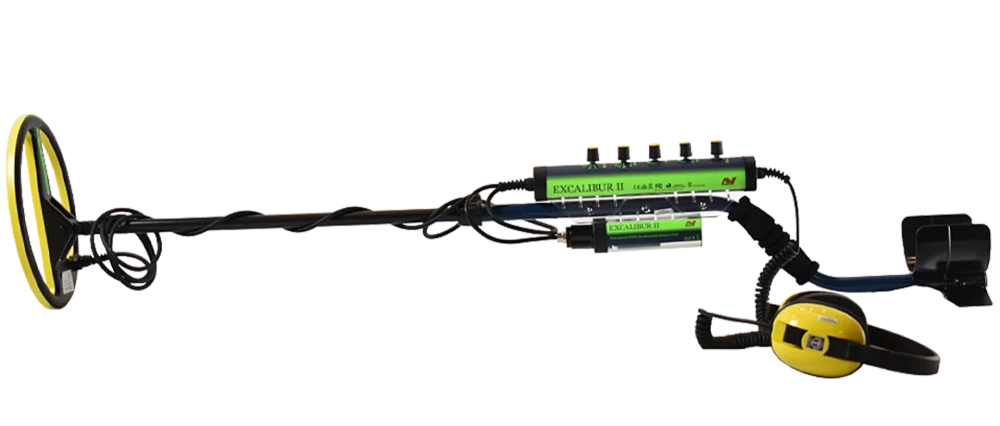
If your plan is to systematically search stretches of seabed or surf rather than recover one recently lost item, the Excalibur II offers a more fitting shape than a pinpointer. Minelab builds it around a full-size search coil, BBS multi-frequency technology, hardwired waterproof headphones, all-metal and discriminate modes, and two shaft configurations—one for regular searching and a shorter dive shaft. The manufacturer’s current specification gives the complete detector a 60 m (200 ft) waterproof rating.
Its advantage is search coverage paired with discrimination by audio tone. Instead of receiving only a basic “metal nearby” indication, you can make more informed decisions about which signals to investigate. Its disadvantages are just as concrete: a listed weight of approximately 2.3 kg (5.1 lb), an older NiMH battery setup, no screen-based target ID, and more bulk to manage during a dive. It is an investment best justified by regular use rather than occasional holiday snorkeling.
- Best for: Regular saltwater searching over larger areas.
- Watch for: Weight, hardwired audio and battery/charging setup.
- Verified with: Minelab’s Excalibur II specification sheet.
2. Nokta PulseDive Scuba Detector — best compact option

The Nokta PulseDive is one of the most practical choices when the search area is small and portability matters. Its pulse-induction operation is designed to remain stable in saltwater, and Nokta gives the Scuba Detector a 60 m (200 ft) waterproof rating. The device provides audible, vibration and LED alerts rather than a conventional target-ID screen. It also has a dive mode that helps prevent accidental button presses under water pressure.
That simplicity is useful when wearing gloves and concentrating on a specific recovery area. It is less convenient for sweeping a broad stretch of bottom, where a larger coil and long shaft can cover ground more efficiently. Nokta sells a related PulseDive 2-in-1 configuration that switches between scuba coil and pinpointer tips; choose the scuba-only unit or the 2-in-1 set according to whether you also need the pinpointer attachment.
- Best for: Localized searches for lost objects and compact dive bags.
- Watch for: Limited search coverage and little ability to identify targets before recovery.
- Verified with: Nokta’s PulseDive Scuba Detector details.
3. Quest Scuba Tector Pro — best folding handheld detector

The Scuba Tector Pro combines a compact body with a folding search coil, a useful distinction from a simple straight pinpointer. Quest describes it as a pulse-induction detector with stable saltwater operation and a 60 m underwater rating. The hinged coil lets you adjust the orientation of the search head and fold it for travel or storage.
For someone who wants a portable underwater tool but prefers a broader scanning head, that arrangement deserves a look. The compromise is that it remains a compact detector: it does not automatically replace the full-size coverage or richer target discrimination of models such as the Excalibur II. The Pro’s folding head is its main reason to choose it over a straight pinpointer; confirm which coil and mounting accessories come with your kit.
- Best for: Divers who prize packability and an adjustable coil position.
- Watch for: Compact sweep coverage and model-version confusion.
- Verified with: Quest’s Scuba Tector Pro listing.
4. Fisher CZ-21 — best deeper-rated detector with audio discrimination
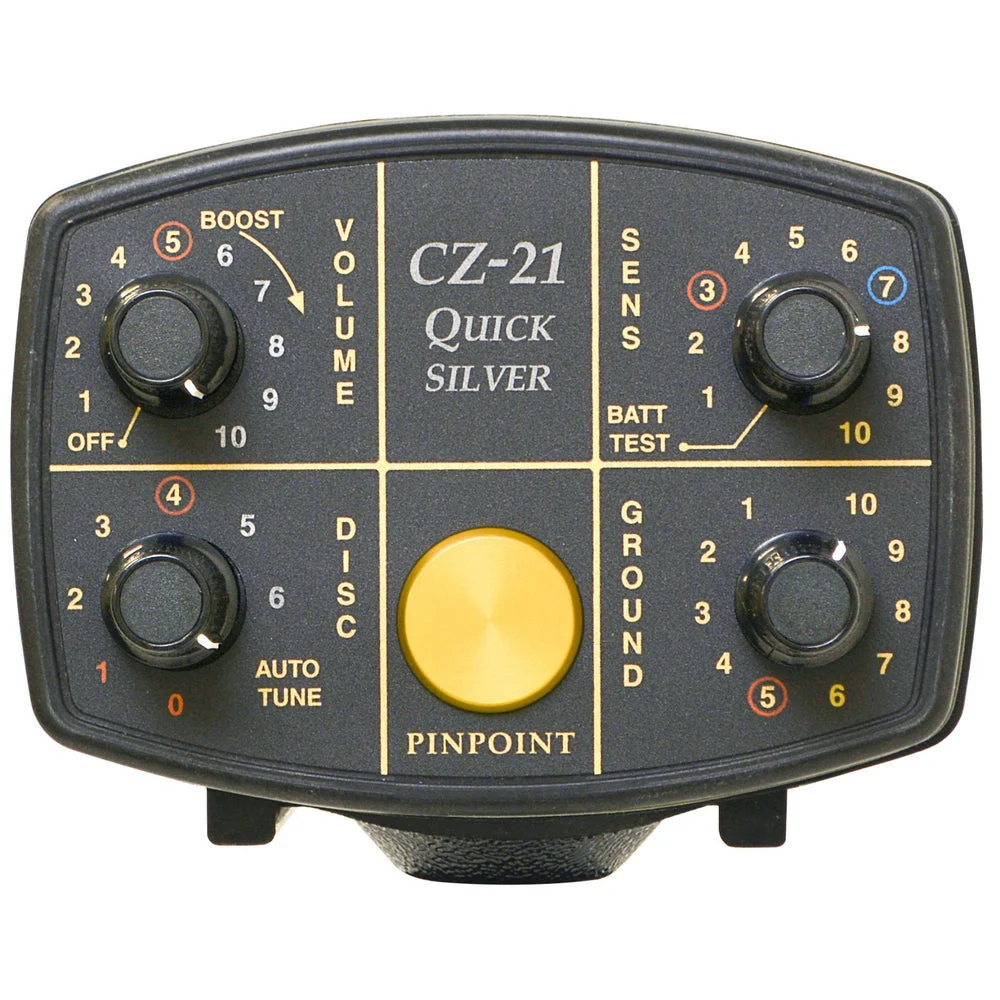
The Fisher CZ-21 takes a more traditional underwater-detector approach, with a shaft, coil, removable control housing and several adjustments that reward practice. Its published specification is 76 m (250 ft) submersion, dual frequencies of 5 and 15 kHz, manual ground balance, pinpointing and three-tone audio target identification. These features make it interesting to divers who want to distinguish broad target categories by sound rather than investigate every indication equally.
The CZ-21 is relatively large and heavy compared with compact handheld detectors, and its controls demand more familiarity. For an experienced user, those are reasonable trade-offs; for a casual swimmer trying to recover a ring, they probably are not.
- Best for: Experienced searchers who value tone ID and manual controls.
- Watch for: Size, weight and availability of the precise coil configuration.
- Verify: Fisher CZ-21 operating manual.
5. XP DEUS II — best for land use plus moderate-depth dives
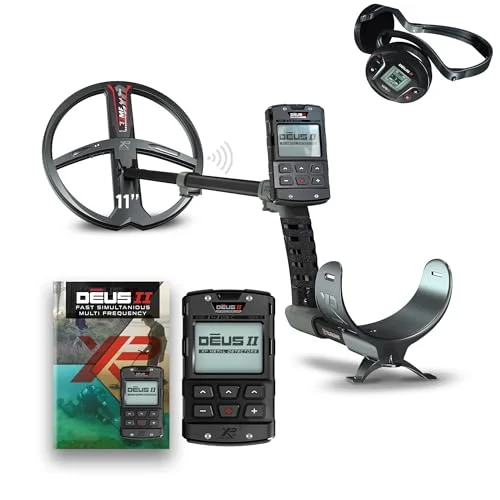
The XP DEUS II is a different sort of recommendation. It is designed to work on land, beaches and underwater, using XP’s Fast Multi Frequency system and a range of configurable programs. For someone who already enjoys detecting on dry land and wants occasional underwater use without owning an entirely separate detector, its versatility is attractive.
The caveat is vital: XP’s diving rating is 20 m (66 ft), substantially shallower than the dedicated 60 m and 76 m models here. The standard grey cap is for land and very shallow submersion; XP instructs users to fit the red cap for immersion beyond 1 m. Full coil submersion also calls for the appropriate underwater aerial antenna arrangement. The linked 11-inch-coil package includes WS6 headphones for land use; these are rainproof, not dive-rated. Underwater use requires compatible waterproof audio, such as XP’s optional BH-01 headphones, plus the specified antenna and cap.
- Best for: Detecting across land, surf and moderate-depth water conditions.
- Watch for: The 20 m limit and extra underwater setup components.
- Verified with: XP’s DEUS II diving instructions.
What really matters when choosing an underwater metal detector
Match the tool to the search area
For a known lost object in a relatively small area, a short handheld tool may be easier to maneuver. For regular searches across a broad swath of sand or seabed, a larger search coil and full-length shaft can be much more efficient. The number of features on the box matters less than the actual type of searching you plan to do.
Understand waterproof depth versus detection depth
A 200-foot waterproof rating means the assembled device is designed to tolerate the water pressure at the specified depth under the maker’s conditions. It does not mean it can detect a ring 200 feet away. Metal detection range varies with target size and type, orientation, sediment, coil size and settings. Check the complete unit, not merely the coil: a beach detector with a waterproof coil and an unsealed control box is not suitable for scuba diving.
Know the technology trade-offs
Pulse-induction (PI) units are commonly used for saltwater and mineralized ground because they can operate stably in difficult conditions. Many compact PI designs, however, offer limited information for rejecting unwanted targets. Multi-frequency and dual-frequency machines may provide more discrimination and broader-area search functions, but they can be heavier and more complicated. Neither detection approach guarantees deeper finds under all conditions.
Check underwater alerts, headphones and seals
A vibration alert or bright LED can be handy underwater; a full-size detector may depend on compatible waterproof headphones. Do not assume ordinary wireless audio will operate while submerged. Before each dive, check the manufacturer’s instructions for O-rings, end caps, charging ports, coil connections and any pressure-specific setting. Rinse saltwater equipment with fresh water after use as directed, and inspect seals again before storage.
Buying checklist
- Confirm the exact model, coil and included accessories rather than relying on a generic listing title.
- Check the manufacturer’s published whole-unit submersion rating for your intended use.
- Choose compact pinpointing or broader search coverage according to the job.
- Consider how target signals will be heard or felt underwater.
- Compare weight, grip, battery system, seals, authorized service and warranty.
- Verify local permission to search, dig or recover metal objects before going in the water.
Safe and responsible underwater searching
Metal detecting is optional equipment; it must not distract from breathing-gas management, buoyancy, situational awareness, your buddy or your dive plan. Never treat a metal detector as a collision-avoidance or safety instrument. Avoid disturbing marine life and fragile habitat. Wrecks and archaeological material may be legally protected, and laws about removing objects differ by location. Leave historic material in place and follow the relevant authority’s guidance.
If you are also refreshing your essential dive equipment, see our dive computer buying guide and dive light comparison.
Final recommendation
The Minelab Excalibur II is our pick for regular full-size saltwater searching, but its weight and cost are hard to justify for occasional use. For targeted underwater recovery, the Nokta PulseDive Scuba Detector is the simpler starting point. Choose the Quest Scuba Tector Pro for its folding-coil design, the Fisher CZ-21 for its deep-rated housing and tonal discrimination, or the XP DEUS II if you want one versatile land-and-water detector and can meet its specific diving requirements.
Frequently asked questions
Which underwater metal detector should a beginner choose?
For a small recovery area, the Nokta PulseDive is a straightforward starting point. Choose the Quest Scuba Tector Pro if a folding coil suits your dive bag. Both cover less ground per sweep than a full-size detector.
Which type works best in saltwater?
Choose a model specifically designed for saltwater. Pulse induction is useful for stable compact searching; multi-frequency or dual-frequency models can offer more target discrimination. All five picks here are intended for saltwater use.
Does a 200-foot rating mean it detects metal 200 feet away?
No. That is the detector’s maximum rated submersion depth. Its ability to detect a buried object depends on the target, coil, settings and ground conditions.
Can I dive with a detector that only has a waterproof coil?
No. The controls, battery compartment, connections and coil must all be rated for your planned submersion. A waterproof coil alone does not make a detector suitable for scuba diving.
Do I need underwater headphones?
Full-size detectors commonly use waterproof headphones. Compact models can provide vibration or visual alerts instead. Ordinary Bluetooth or wireless headphones should not be relied on underwater.
What extra equipment does the XP DEUS II need for diving?
Follow XP’s diving configuration: the correct pressure cap, an underwater antenna and compatible waterproof audio. The linked kit’s WS6 headphones are for land use, not diving. The detector’s maximum diving rating is 20 m (66 ft).

Hi, I’m Abi. I am a passionate blogger. I love writing about my passions: fitness, water sports, travel, and food. I also love getting to know new people and cultures through travel. When I’m not writing or traveling, you can find me coding up a storm!