

The best dive lights match the dive you actually do: a manageable beam for a night dive, enough useful runtime for the plan, and controls you can operate with gloves. The largest lumen claim alone does not make a torch the best choice.
Quick verdict: The OrcaTorch D710 is our first choice here for recreational divers who want a focused handheld light. Choose the D630 V2.0 when you specifically need a canister system and longer published burn time. The APLOS AP150 is an alternative for divers who prefer a rotary control. Older SOLA models and the Mares strobe have different roles, explained below.
As an Amazon Associate, we earn from qualifying purchases.
Dive light comparison
| Light | Best fit | Output | Beam / depth | Published runtime | Main trade-off |
|---|---|---|---|---|---|
| OrcaTorch D710 | Recreational handheld pick | 1,700 lm high; 3,000 lm temporary turbo | 6° spot; 150 m rating | 1 h 40 min on high | Check stock; spot beam is unsuitable for wide video |
| OrcaTorch D630 V2.0 | Canister pick for a technical setup | 4,600 lm high, current version | 7° spot; 150 m rating | 4 h 20 min on high | Cable, canister and greater weight |
| APLOS AP150 | Rotary-switch alternative | 15,000 lm advertised maximum | 150 m manufacturer rating | Comparable sustained-output runtime not confirmed | Large headline output is not proof of longer burn time |
| Genwiss dive torch | Budget listing to assess cautiously | Exact version needs checking | Verify the supplied manual | Not confirmed for the linked version | Documentation and model consistency |
| SOLA Dive 2500 S/F | Older spot/flood option | 2,500 lm flood; 1,200 lm spot | 60° flood / 12° spot; 100 m rating | 50 min flood / 60 min spot on high | Discontinued; battery and service support |
| Double Dive 2X 15K Kit | Older camera-lighting kit | Two 15,000 lm video lights | Wide flood lighting | Check the exact kit and battery condition | Discontinued; specialist imaging equipment |
| Mares EOS Strobe | Signalling accessory | Visibility strobe, not a primary torch | 120 m current manufacturer rating | Up to 25 h strobe operation | Cannot replace a directional dive light |
Output, depth and burn-time figures are published specifications, not guarantees for every battery or condition. Maximum output and maximum runtime usually describe different settings. The three final entries are specialist or older equipment, not interchangeable primary-light recommendations.
Our main dive light picks
1. OrcaTorch D710 – our recreational handheld pick
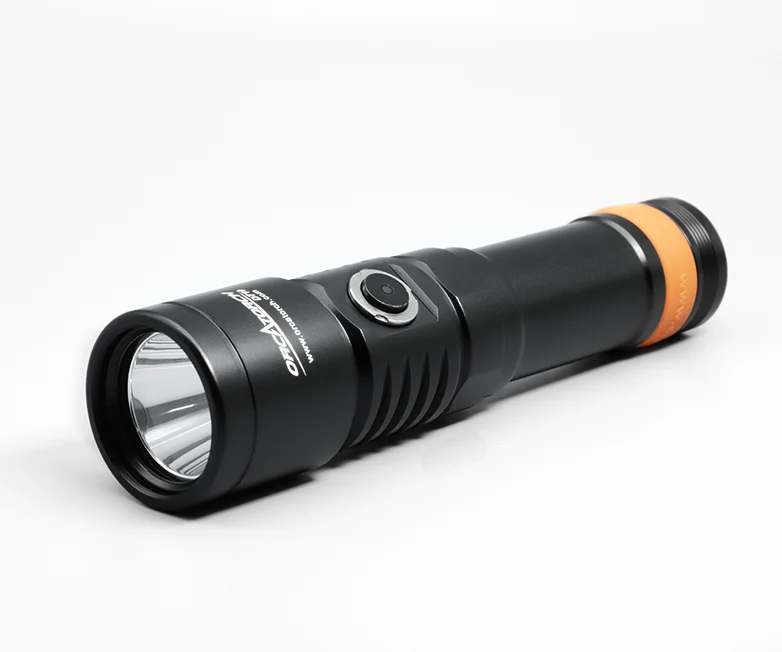
The D710 is the most straightforward starting point here for a diver who wants a compact directional torch without a separate battery canister. Its 6° beam concentrates light for looking into crevices and communicating with a buddy. It is a spot light rather than a broad, even video light.
The useful number is 1,700 lumens on high, not the temporary 3,000-lumen turbo. OrcaTorch lists 1 hour 40 minutes at that high setting. A replaceable 21700 battery, side button, battery indicator and switch lock make it a practical package. The Type-C charging connection is on the compatible supplied battery; do not assume you can charge through the light body.
- Choose it for: recreational night diving and daytime inspection when a narrow beam suits your conditions.
- Main drawback: limited scene coverage for filming; turbo is not an all-dive operating level.
Availability: The linked Amazon listing showed no available offer during our November 5, 2026 update. Check stock before planning around it, or use OrcaTorch’s product and dealer information.
2. OrcaTorch D630 V2.0 – our canister pick

Choose the D630 for a planned canister-light setup, not simply because it has more output than a handheld torch. The separate battery pack and adjustable cable suit divers who already know how they want to mount and route their equipment.
The current D630 V2.0 is listed at 4,600 lumens with a 7° beam. Its published high-mode burn time is 4 hours 20 minutes, with a 150 m depth rating and an 89 Wh battery pack. It uses a side button, not the rotary switch described in the older article.
- Why choose it over the D710: substantially longer published high-mode runtime and a canister layout.
- Why skip it: the complete system weighs about 1.42 kg on land and adds a cable and mounting decisions that many recreational divers do not need.
Check the version before ordering: older D630 descriptions quote 4,000 lumens. Buying a technical light does not qualify a diver for cave or wreck penetration; those dives require appropriate training, planning and redundant equipment.
3. APLOS AP150 – a rotary-switch alternative

The AP150 makes sense if you prefer rotating a control ring to pressing a small button. APLOS advertises 15,000 lumens, four XHP50.2 LEDs, a 150 m depth rating and two rechargeable 26650 batteries. Its modes include high, medium, low and SOS.
Treat the output figure as an advertised maximum. Without a comparable sustained-output runtime figure, it should not automatically outrank a lower-lumen light with a clearly documented burn time. The two-cell arrangement also means more battery bulk and charging logistics than the D710.
- Choose it for: a handheld design with a rotary control and adjustable output.
- Check before buying: high-mode runtime, battery and charger contents, the exact model, and seller warranty terms.
4. Genwiss dive torch – a budget option with conditions

Genwiss is worth inspecting if your budget is tight, but we would not give an inexpensive marketplace listing an unconditional primary-light recommendation. Similar-looking versions circulate with different specifications, and the linked version’s operating details need to be checked against its own manual.
Before buying, confirm a stated diving depth, usable burn time at your intended brightness, battery type and a workable return policy. Do not treat beam-distance claims as a depth rating. If those details are missing, choose a better-documented light rather than guessing.
Our view: a conditional budget alternative, not the first choice for a primary night-diving light. Our Genwiss dive light review gives more context; match any specifications to the exact listing you order.
Specialist and older lights from the original shortlist
These products remain here to explain their actual roles and the compromises of buying older equipment. They are not additional winners in the recreational shortlist.
5. Light & Motion SOLA Dive 2500 S/F – older spot/flood option

Check Legacy Listing on Amazon
The attraction of the SOLA is switching between a 12° spot at 1,200 lumens and a 60° flood at 2,500 lumens. Published high-mode runtimes are 60 minutes in spot and 50 minutes in flood, with a 100 m depth rating. Its control is a sliding switch; the previous push-button and SOS description should not be used.
Buying limitation: Light & Motion has ceased operations. Backscatter lists this model as discontinued. A used or old-stock unit only makes sense after checking battery condition, charger compatibility and a named repair route. For a first light, we would favor a currently supported product.
6. Light & Motion Double Dive 2X 15K Kit – older video-lighting kit

Check Legacy Listing on Amazon
This is equipment for illuminating a camera scene, not a practical substitute for a handheld navigation torch. The kit combines two 15,000-lumen video lights; two light heads give you control over coverage and positioning, rather than one concentrated 30,000-lumen beam.
Consider it only if you already need that imaging setup and can verify the exact port, mounts, battery modules and charging equipment included. With the manufacturer no longer operating, service and battery condition matter more than the original headline specification. We would not choose it as a first general-purpose dive light.
7. Mares EOS Strobe – signalling accessory
Check Strobe Listing on Amazon
The original Mares link identifies an EOS Strobe. That is a visibility and signalling accessory, not the focused EOS torch described in the previous text. Mares currently lists a 120 m operational depth and up to 25 hours of strobe operation.
Consider it only if a marker or strobe fits your dive plan and local procedures. Its signalling role is separate from lighting the route ahead. It does not replace either your primary directional light or an independent backup torch.
How to choose the right dive light
Start with the job, not the lumen number
- Recreational primary: prioritize a comfortable grip, a useful beam, dependable controls and burn time at the setting you will use.
- Backup: choose an independent light you can reach and operate easily. Check its battery before the dive, even if it normally stays in a pocket.
- Technical primary: select mounting, cable routing, beam and reserve capacity around your training and dive plan.
- Video: look for even coverage, an appropriate underwater beam angle and compatible mounts. A bright narrow spot can leave a distracting hotspot.
- Marker or strobe: use it for identification or signalling according to the plan; keep its role separate from a torch.
Match the beam to the water
Lumens describe total light output; beam angle describes how that output is distributed. A narrow beam concentrates light into a small area. A flood covers more of a scene but spreads the same total output over a wider area. Neither is universally better.
In particulate water, more brightness can light up suspended particles and make the view worse. A focused beam and a lower setting can be more useful than maximum power. For video, even coverage and sensible light positioning matter more than simply adding lumens.
Compare output and runtime at the same setting
Ask: How long does this light remain useful at the brightness I intend to use? A maximum-output figure beside a low-mode runtime does not answer that question. Look for a mode-by-mode specification and distinguish momentary turbo from a normal operating level.
For example, the D710’s 3,000-lumen claim describes temporary turbo; its documented high mode is 1,700 lumens. The D630’s current high-mode figure pairs 4,600 lumens with 4 hours 20 minutes. Plan a reserve rather than using a published laboratory runtime as your whole allowance.
Check what charging and battery replacement involve
For repetitive dives, think through the interval between dives. Can you swap a suitable charged battery, or must the whole unit be recharged? Does the charger fit your travel setup? Is the USB port on the battery, a separate accessory or the light itself?
A factory-sealed light reduces routine opening, but battery replacement may depend on a service provider. A user-replaceable battery adds flexibility while also making correct sealing and battery handling part of your routine. Follow the exact manual rather than transferring instructions from a similar-looking model.
Check controls, sealing and support
Try the switch with the gloves you dive in. Make sure you can change brightness without repeatedly entering a flashing mode. A lock helps avoid accidental activation in a bag; a battery indicator is useful but does not replace a pre-dive check.
Buy a light with a specific diving-depth rating, not only a generic waterproof label. Inspect the sealing surfaces and O-rings as the manufacturer directs, rinse after saltwater use, and dry the light before opening a battery compartment. Check spare seals, battery availability and the seller’s service arrangements before ordering.
Before you order
- Match the model name and version across the listing, manual and battery bundle.
- Compare burn time at the output you will actually use.
- Confirm the battery, charger and any handle or wrist mount included.
- Check the return policy, warranty provider and replacement parts.
- For older stock, ask about battery age, storage and service options.
- Budget for the backup light and spare power your dive plan calls for.
Final verdict
For a recreational diver choosing from this guide, the OrcaTorch D710 offers the clearest starting point: a focused handheld beam, replaceable power and documented high-mode runtime. Check availability before committing.
For a trained diver specifically building a canister setup, choose the OrcaTorch D630 V2.0 for its longer published high-mode burn time. Consider the APLOS for its rotary control only after checking runtime and battery details. The Genwiss remains a conditional budget listing; the discontinued SOLA products and Mares strobe should not be mistaken for equivalent recreational primary lights.
Dive light FAQs
How many lumens do I need for a dive light?
There is no single minimum that suits every dive. Beam pattern, water clarity and usable runtime matter alongside output. Start with a manageable light and a documented operating level; a large turbo claim alone is not a good buying target.
Which light in this guide is best for recreational night diving?
The OrcaTorch D710 is our recreational handheld pick when its narrow beam suits the dive. The D630 is the specialist canister option. Carry an independent backup light and select equipment with your instructor or dive operator for the conditions.
Do I need a backup light for night diving?
Yes. Carry an independent backup you can reach easily and check both lights before entering the water. Additional lighting requirements for overhead or technical dives belong to the training and dive plan.
Can I use an ordinary waterproof flashlight for scuba diving?
Only if its manufacturer explicitly rates it for the intended diving depth and underwater use. A waterproof or IPX8 label by itself does not establish a suitable scuba depth rating.
Can one light work for diving and underwater video?
A model with separate spot and flood modes can serve both roles, but check the underwater beam angle and mounting options. A narrow handheld spot is usually a poor choice for evenly lighting a wide camera scene.
Are the older Light & Motion lights still worth buying?
Only with clear answers about battery condition, charger availability and repair support. The manufacturer has ceased operations, so old stock or used equipment needs more scrutiny than an ordinary new-light purchase.
Is the Mares EOS Strobe a backup dive torch?
No. It is a signalling and visibility accessory. A backup torch must provide useful directional light if the primary fails; a strobe serves a different purpose.
Specification references: OrcaTorch D710, D630 V2.0, APLOS AP150 and Mares EOS Strobe. For lighting roles and backup guidance, see PADI’s dive light guide.

Makiza Upin is a 28-year-old business graduate from the University of Santo Tomas. She has been writing since she was in grade school and loves to dive into the world of words as much as she loves to explore the depths of the ocean.
Makiza writes articles about all kinds of topics, including water sports, , travel, and health. She also writes fiction under her pen name. She enjoys diving and eating good food—so much so that she’s been known to combine both into one activity with friends!